China
China Pусский
 Español
 EN
ENSilver Rivet Contact Failures Start Here?
A relay in a motor control panel fails to close. A circuit breaker trips repeatedly without an overload. A push button switch stops responding. Each of these failures often traces back to the same small component: the Silver Rivet Contact. These tiny parts are the workhorses of low‑voltage switching devices, responsible for making and breaking electrical connections thousands of times per day. When a Silver Rivet Contact fails, the symptoms are unmistakable—overheating that darkens the contact surface, welding that locks the contacts together, or high resistance that prevents current from flowing at all. Most failures follow predictable patterns: a black tarnish that signals harmless silver oxide, green or black corrosion that indicates contamination, or pitting and material transfer from arcing. This guide walks through how to spot each failure, what causes it, and the practical steps to restore reliable operation without replacing the entire device.
What the color and texture of the contact tell you
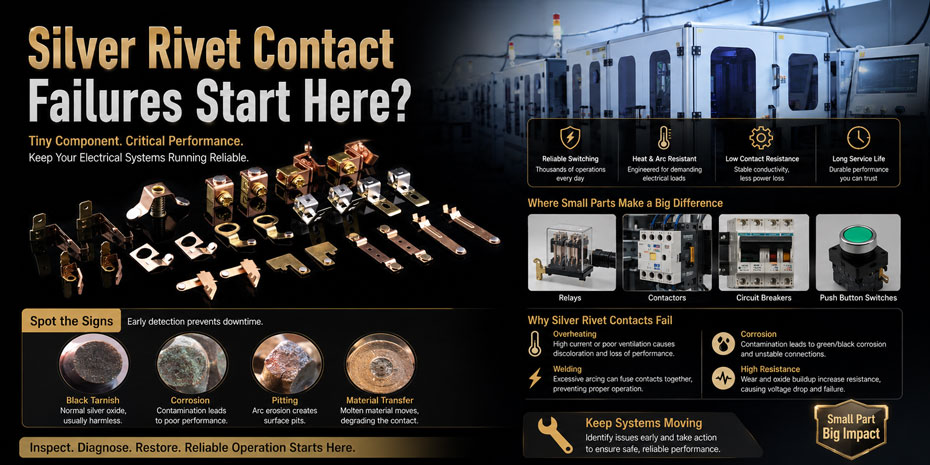
Not all discoloration on a Silver Rivet Contact means failure. Silver oxide forms naturally when silver is exposed to air—it appears as a light gray to brownish‑black tarnish. Unlike copper oxide, silver oxide remains conductive. A uniformly darkened contact that still shows a clean, intact surface is usually safe to use. The oxide layer can even be reduced back to metallic silver during normal switching operations.
Green or black corrosion tells a different story. When contaminants—sulfur compounds from industrial environments, salt spray from coastal installations, or out‑gassing from nearby plastics—react with the silver surface, they form non‑conductive corrosion products. These layers increase contact resistance, generate heat during operation, and eventually cause the contact to overheat and fail. If the contact surface appears green, black, or crusty, the corrosion layer must be removed.
Pitting, cratering, or material transfer indicates arc damage. Every time a relay or contactor opens under load, a small arc forms across the separating contacts. Over thousands of operations, this arc erodes material from one contact and deposits it on the other, creating a pip‑and‑crater pattern. Severe pitting reduces the effective contact area, increases resistance, and accelerates heat generation. Once pitting exceeds about 30% of the original contact thickness, the Silver Rivet Contact must be replaced.
Why contacts overheat, weld, or go high‑resistance
Three root causes account for most Silver Rivet Contact failures. Surface contamination is the most common and easiest to fix. Oil from assembly, sulfur from industrial air, or out‑gassing from nearby plastic components deposits a non‑conductive layer that raises contact resistance dramatically. Insufficient contact pressure—a weak spring, misaligned actuator, or worn return mechanism—prevents the contacts from achieving the necessary force to break through surface films. The resulting high resistance generates localized heating that can weld the contacts together. Material mismatch occurs when the silver alloy composition doesn‘t match the switching application. AgNi (silver‑nickel) offers good arc transfer characteristics and low resistance for medium currents; AgSnO₂ (silver‑tin oxide) provides superior anti‑welding performance and arc erosion resistance for higher inrush loads like motors and capacitive circuits. A contact specified for a resistive lighting load will fail quickly on an inductive motor circuit.
What you can clean and what you must replace
Cleaning oxidized or contaminated surfaces. If the Silver Rivet Contact shows light gray to dark brown tarnish but the surface is otherwise smooth, no cleaning is required—the oxide layer is conductive and harmless. For green or black corrosion that increases contact resistance, gently clean the contact surface with a soft brush and isopropyl alcohol. Never use sandpaper or files on silver contacts; abrasive cleaning removes the precious metal layer and changes the contact geometry. In severe cases, replace the contact entirely.
Restoring contact pressure. A contact that operates intermittently or feels loose when the relay is actuated points to insufficient pressure. Check the contact spring for deformation or fatigue. A weakened spring cannot be repaired—replace it with a spring of the same force rating. Ensure the actuator stroke fully closes the contacts; if the device stops moving before full closure, adjust the travel limiter.
Addressing material mismatch after replacement. If a new Silver Rivet Contact fails in the same pattern as the old one—repeated welding, rapid pitting, or excessive heating—the contact material may be wrong for the application. For high‑inrush loads (motors, capacitors, transformers), upgrade to an AgSnO₂ or AgNi contact; for pure resistive loads, standard fine‑grain silver suffices. Saijin offers a full range of silver alloy compositions tailored to specific switching environments.
Two signs that mean stop cleaning and start replacing
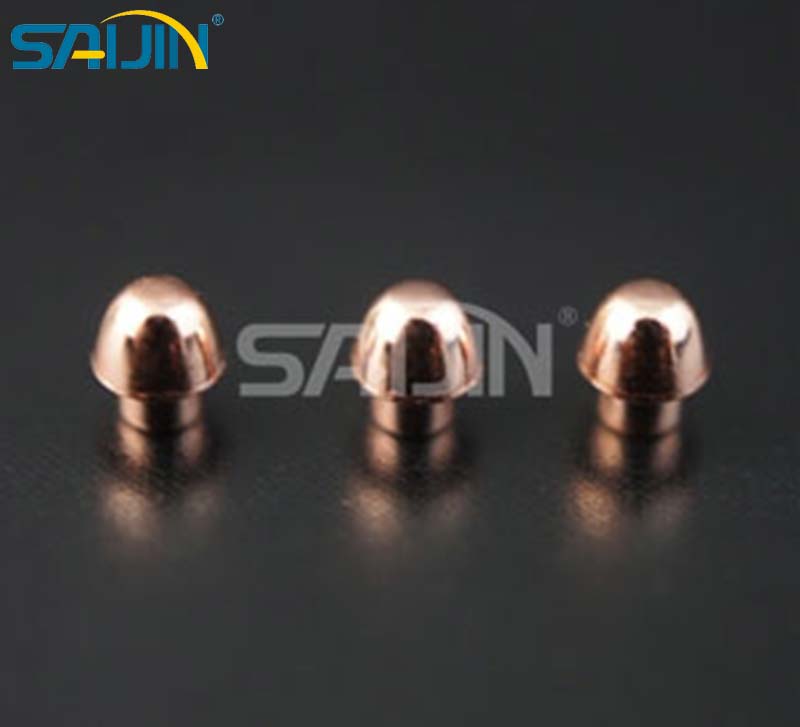
A Silver Rivet Contact that has melted, shows a crater deeper than 0.2 mm, or has transferred so much material that the surfaces no longer mate evenly cannot be repaired in the field. Replace the contact or the entire contact assembly. In bimetal rivet designs, the silver alloy head is bonded to a copper body. If the bond has failed or the copper is exposed, replacement is required. Saijin‘s Relay Round Contact Rivets are designed for consistent material composition and dimensional accuracy, ensuring reliable replacement compatibility with original equipment specifications.
At‑a‑glance guide to what the surface says
| Failure Sign | Likely Cause | Corrective Action |
|---|---|---|
| Light to dark brown tarnish, surface smooth | Normal silver oxide, still conductive | No action needed |
| Green, black, or crusty discoloration | Corrosion from contaminants | Clean with soft brush and alcohol; replace if pitted |
| Pitting or cratering (>0.2 mm depth) | Arc erosion from repeated switching | Replace contact |
| Melted or welded contacts | Excessive current or inrush | Replace; upgrade to higher-rated alloy |
| Intermittent operation | Insufficient contact pressure or misalignment | Check spring force; adjust travel |
Answers to the questions you actually get from the floor
Q: Why does my silver contact look black but still work fine? A: Silver oxide is naturally conductive. A uniformly darkened Silver Rivet Contact with a smooth surface does not need replacement. The oxide layer can actually improve wear resistance and may reduce back to metallic silver during use. If the contact is black and pitted or crusty, replace it.
Q: What‘s the difference between riveted and welded silver contacts? A: Riveted contacts are mechanically attached to the carrier spring using a riveting tool, which deforms the copper foot to lock it in place. Welded contacts are attached using resistance welding. Riveting is common for field‑replaceable contacts; welding provides a more permanent bond but requires specialized equipment for replacement.
Q: Can I replace a silver rivet contact myself? A: Yes, if you have the correct riveting tool and a replacement contact that matches the original dimensions. Insert the rivet shank into the hole in the contact spring, place the assembly on a hard anvil, and peen the copper foot with a rivet punch until it flares and locks the contact in place. For bimetal rivets, maintain proper alignment to avoid cracking the silver‑copper bond.
Q: What causes a silver contact to weld closed? A: Contact welding occurs when the arc during contact separation melts the contacting surfaces, and they solidify while still touching. This is most common when switching inductive loads (motors, solenoids) or capacitive loads (power supplies, LED drivers). Using a contact alloy with higher anti‑welding properties, such as AgSnO₂, reduces the risk.
When the same failure keeps coming back
Repeated failures of the same type—welding every month, rapid pitting after 10,000 operations, or overheating even after cleaning—indicate that the Silver Rivet Contact material does not match the application. AgNi (silver‑nickel) contacts offer good arc transfer characteristics, low contact resistance, and stability, making them suitable for medium‑current switching in relays, contactors, and general‑purpose switches. AgSnO₂ (silver‑tin oxide) contacts provide superior anti‑welding performance and arc erosion resistance, ideal for high‑inrush applications like motor control and power distribution. AgCdO (silver‑cadmium oxide) handles heavy switching loads but is being phased out due to environmental regulations. Work with the manufacturer to select the correct alloy based on load type (resistive, inductive, capacitive), switching frequency, and required electrical life.
How Saijin builds contacts you can trust
When reliability depends on consistent contact performance, the quality of the Silver Rivet Contact and the manufacturing process behind it determine system uptime. Saijin specializes in electrical contact components, including the Relay Round Contact Rivets designed for low‑voltage apparatus such as relays, contactors, switches, thermostats, and timers. The product is suitable for applications requiring high‑frequency switching, such as motor control and power distribution. Saijin‘s quality inspection processes include material hardness testing, assembly line random inspection, automatic contact detection equipment, projection detection, and quality inspection screening. Certificates comply with EU RoHS and REACH requirements. With more than 20 years of service experience, Saijin offers technical support, sample verification, and production flexibility for custom contact configurations.
→ Request a quote from Saijin for the Relay Round Contact Rivets — Share your application (relay, contactor, switch), load type (resistive, inductive, capacitive), switching frequency, and environmental conditions. Their technical team can recommend the right silver alloy composition and contact dimensions for your specific device.