China
China Pусский
 Español
 EN
ENWhy do tungsten rivets outlast silver?
A car horn engineer in Germany watched a silver‑plated contact fail after 15,000 cycles. The contact face had melted, transferred material to the opposite pole, and welded shut. The horn still clicked, but the current path was open. The fix was a tungsten rivets contact — pure tungsten head, no silver overlay, nothing to melt and transfer.
A tungsten rivets contact is made from tungsten (chemical symbol W), a refractory metal with a melting point of over 3,400°C — the highest of any metal group. It is used as the contact point in switches, responsible for making or breaking a circuit, where an arc forms across the contact gap with each operation. The extreme heat of the arc (3,000‑5,000°C) melts most metals instantly; tungsten stays solid. The material also has strong arc resistance, helping prevent electrical discharge due to high voltage between contacts and ensuring the stability and safety of the circuit. The density of the tungsten rivets is ≥19.0 g/cm³, and the hardness is 680 HV(Mpa).
The Electric Solid Tungsten Point from Saijin is a solid tungsten rivet manufactured by powder metallurgy — pressing high‑purity tungsten powder into a die and sintering at 1,500‑2,000°C to bond the particles. The result is a contact with ≥99.95% tungsten purity, density of at least 19.0 g/cm³, and a grain count of 10,000‑20,000 PCS/mm². This article explains why tungsten does not melt when silver does, how the powder metallurgy process creates a pore‑free contact face that outlasts machined tungsten, and where the electric solid tungsten point fits between pure tungsten and silver‑tungsten composites.
Tungsten vs silver: why the metal with the highest melting point is also cheaper than its silver counterpart
Silver melts at 961°C. A silver‑based contact operating at high inrush currents will reach this temperature at the contact spot, and the silver will transfer from one pole to the other. The material transfer, or “pip and crater,” eventually bridges the contact gap, welding the contacts together.
Tungsten melts at 3,422°C, a temperature that a switching arc cannot reach. The tungsten contact remains solid, and the arc erodes the surface gradually rather than transferring molten metal from one side to the other. The arc erosion resistance of silver/tungsten material is superior to other silver‑based contact materials. The failure mode changes from sudden welding to progressive wear, which can be monitored and predicted.
The product description includes an unexpected advantage: tungsten rivets are cheaper than any other metal or alloy material for the same application. A silver‑tungsten contact (typically 50‑70% silver, 30‑50% tungsten) carries the cost of silver — currently €600‑800/kg. A pure tungsten contact carries the cost of tungsten powder and the processing steps, which is significantly less. For a high‑volume automotive horn manufacturer, the material cost saving per rivet, multiplied by millions of units, can exceed the tooling cost.
| Material | Melting Point (°C) | Arc Erosion Resistance | Relative Cost | Failure Mode |
|---|---|---|---|---|
| Fine silver | 961 | Poor (welding) | High | Sudden welding |
| AgNi (silver-nickel) | 961 (silver matrix) | Good | Medium | Gradual erosion |
| AgSnO₂ (silver-tin oxide) | 961 (silver matrix) | Very good | Medium‑high | Gradual erosion |
| AgW (silver-tungsten) | ~1,200 (silver melts first) | Excellent | Medium | Controlled erosion |
| Pure tungsten (W) | 3,422 | Excellent | Lower | Progressive wear |
The pure tungsten contact has the highest melting point and the lowest material cost of the group, but it lacks the conductivity of silver and the low contact resistance of silver alloys. For applications where contact resistance is not the primary concern — such as AC circuits where the arc extinguishes every half cycle — tungsten is the logical choice.
The powder metallurgy advantage: why pressed‑and‑sintered tungsten outlasts machined tungsten
A tungsten rivets contact made by machining from a tungsten rod has one weakness: the grain structure is elongated and anisotropic. When the contact face erodes under arcing, the material flakes off along the grain boundaries, accelerating wear.
The manufacturing of tungsten rivets begins with choosing and preparing high‑purity tungsten powder. Tungsten, a rare metal with a melting point over 3,400°C, is sourced from ores like wolframite and scheelite. These are crushed and processed chemically and physically to obtain pure powder. High‑purity powder is vital because impurities can impact the rivets’ quality, ensuring good mechanical properties like strength, wear, and corrosion resistance. The powder is put into a mold of the desired rivet shape, and high pressure compresses the powder, reducing porosity and increasing density. This gives the basic shape, but the rivets are fragile at this stage. Pressure and time are carefully controlled for uniform density. The green rivets are then sintered in a furnace under a controlled atmosphere, usually vacuum or inert gas, at around 1,500‑2,000°C — below tungsten’s melting point — where particles bond. This increases strength and density, and changes the microstructure, reducing or removing pores.
The resulting grain structure is isotropic — equiaxed grains in all directions. When the arc strikes the contact face, the wear is uniform, and the contact does not develop stress risers that lead to cracking. For a tungsten rivet in a automotive horn that cycles at 200‑300 Hz, the isotropic grain structure extends the life by 2‑3 times compared to a machined tungsten contact of the same dimensions.
After sintering, machining like turning, milling, and drilling may refine the rivets to their final size and surface finish, shaping the head and shank to fit the specific application, ensuring tight tolerances for high‑precision use. The standard dimensional tolerances are: Head Diameter ±0.10 mm, Head Thickness ±0.05 mm, Shank Length ±0.15 mm, Shank Diameter -0.02 to -0.10 mm.
Why the powder metallurgy grade is called "Wu" or "W"
The raw material is referred to as "Wu" or "W" in the product catalog, both indicating tungsten. Wu is the Chinese character form (钨). The material composition is ≥99.95% tungsten, with grain numbers of 10,000‑20,000 per square millimeter, and hardness of 680 HV(Mpa). The high grain count — 10,000‑20,000 grains per square millimeter — is the result of fine‑grained powder metallurgy. In a tungsten contact, smaller grains mean more grain boundaries, which act as barriers to crack propagation. A coarse‑grained tungsten contact will develop micro‑cracks earlier in its service life. The fine grain structure of the Saijin tungsten rivets contributes directly to the product’s extended contact life.
The standard shapes are available in shank diameters of 1.5‑3.0 mm, head diameters of 3‑6 mm, and shank lengths of 1.5‑3.0 mm. Standard dimensions include: Shank Diameter (d) of 1.5‑3.0 mm, Head Diameter (D) of 3‑6 mm, Shank Length (L) of 1.5‑3.0 mm. Full customization is available for non‑standard sizes and shapes.
Electric solid tungsten point: where a pure tungsten head is the only choice
A tungsten rivets contact used in a high‑voltage circuit breaker must withstand a single fault current of 10,000A or more. The arc energy is massive, enough to vaporize silver. A pure tungsten contact may survive the fault without welding, while a silver‑based contact will melt and fuse. In this application, the contact resistance is not critical because the breaker opens only under fault conditions, and the closed‑contact resistance is a secondary concern to the ability to interrupt the fault without destruction.
For an electric horn, the considerations are different. The contact opens and closes at the frequency of the sound (200‑300 Hz), and the arc occurs on every cycle. A pure tungsten contact provides the wear resistance to survive millions of cycles, but the contact resistance is higher than silver. The horn's output volume depends on the current through the coil; a high‑resistance contact reduces the current and the horn sounds weak. The Electric Solid Tungsten Point is specified for applications where arc wear is the primary failure mode and where a small loss in conductivity is acceptable.
The product supports full customization of size, head shape (flat, domed, countersunk), and shank length to match the customer’s assembly. The shank tolerances (-0.02 to -0.10 mm) ensure a tight press‑fit into the contact arm without cracking the tungsten. An interference fit that is too tight — less than -0.02 mm clearance — will crack the tungsten during installation because tungsten is brittle. The specified tolerance provides enough clearance for assembly while still achieving mechanical retention.
How the size table helps a design engineer
The standard dimensions for tungsten rivets include: Shank Diameter (d) of 1.5‑3.0 mm, Head Diameter (D) of 3‑6 mm, Shank Length (L) of 1.5‑3.0 mm. A contact with a 3 mm head diameter and 1.5 mm shank diameter fits a small automotive relay. A contact with a 6 mm head diameter and 3 mm shank is used in a medium‑voltage contactor. The head thickness is specified separately; a thicker head provides more tungsten mass for arc erosion before the contact fails. For a horn that must survive 200,000 cycles, the head thickness should be at least 1.5 mm. For a relay that cycles 10,000 times over its life, a 1.0 mm head thickness is sufficient.
Applications where a tungsten rivet outlasts silver‑based contacts: horns, relays, contactors, circuit breakers
Tungsten rivet contacts are used as contact points in switches, responsible for making or breaking a circuit. When the circuit needs to be energized, the contacts touch each other to allow current to pass; when the circuit needs to be disconnected, the contacts separate, and the current is interrupted. The main functions are:
-
Circuit making and breaking: Tungsten rivet contacts are used as contact points in switches, responsible for making or breaking a circuit. They are ideal for automotive horns, where the contacts open and close at high frequency, and the tungsten surface resists arc erosion better than silver.
-
High melting point, arc resistance: Tungsten has an extremely high melting point (3,400°C), allowing tungsten rivet contacts to withstand high temperatures without deforming or melting. The material also has strong arc resistance, helping prevent discharge due to high voltage between contacts and ensuring the stability and safety of the circuit.
-
Low resistance, efficient conduction: Tungsten has excellent electrical conductivity, allowing current to pass through contacts effectively, reducing power loss and heat generation, and improving the efficiency of electrical equipment.
-
Durable and stable: Tungsten contacts are known for their durability and long life. They can maintain stable performance over long periods of use, reducing the frequency of maintenance and replacement. They also have good corrosion resistance and are particularly suitable for use in humid, corrosive or harsh environments, such as automotive interiors.
The product is widely used in automobiles, motorcycles, electric horns, magnetos, and other electrical products requiring high‑current interruption. Tungsten contacts for electrical products are suitable for high‑end power connections such as large generators, transformers, etc., to ensure no break point in current transmission and ensure the safe operation of the system. The rivet is corrosion‑resistant and wear‑resistant for extended service life.
The Electric Solid Tungsten Point is also used as the moving contact in AC contactors, where the switching frequency is low but the arc energy per operation is high. The tungsten surface does not transfer material, so the contact gap remains consistent over the life of the contactor. For a motor starter that operates a few times per day, the tungsten contact may last the life of the equipment.
Why a tungsten rivet costs less than you think — and why the installation cost is higher
The material cost for a tungsten rivet is lower than for a silver‑tungsten composite contact of the same size. However, the tungsten head is brittle. The riveting process — pressing the shank into the contact arm — can crack the tungsten if the interference fit is too tight or the press is misaligned. The installation tool must be calibrated to apply force axially without side‑loading the head. A cracked tungsten head may still pass a continuity test but will fail after a few thousand cycles when the crack propagates under thermal stress.
A manufacturer switching from silver‑tungsten to pure tungsten must also adjust the torque spec for the contact arm. Tungsten has a coefficient of thermal expansion (4.5×10⁻⁶/K) that is significantly lower than copper (17×10⁻⁶/K) and brass (19×10⁻⁶/K). The contact arm expands more than the tungsten contact during operation, creating a compressive stress that can crack the head if the design does not account for it. An expansion gap or a flexible mounting reduces the stress.
For a high‑volume automotive supplier running 10,000 tungsten rivets per day, the installation yield must be 99.99% or better. Saijin provides sample rivets for installation testing, and the technical team supports the customer’s assembly line setup, including riveting force and alignment verification.
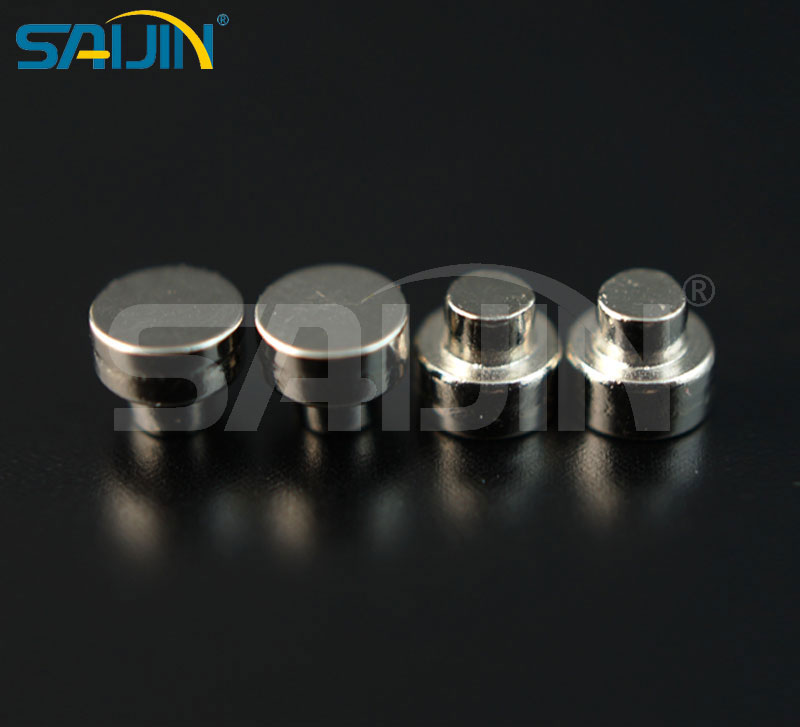
How the electric solid tungsten point fits into a switch or relay assembly
Saijin Electric (Wenzhou Saijin Electrical Alloy Co., Ltd.) has manufactured tungsten rivets, silver contacts, and electrical accessories for over 20 years. The Electric Solid Tungsten Point is part of the company’s tungsten contact line, which includes Solid Tungsten Rivets, Half Hollow Tungsten Contact Rivets, Copper Alloy Tungsten Contacts, and Electrical Wu Tungsten Contacts. The manufacturing process uses high‑purity tungsten powder, powder metallurgy compaction and sintering, optional machining to final dimensions, and 100% dimensional inspection with ±0.10‑0.05 mm tolerances.
A tungsten rivets product that does not melt when silver does, resists arc welding in automotive horns and high‑voltage switches, and costs less than silver‑tungsten alternatives delivers the arc resistance, dimensional precision, and installation support that a contact manufacturer requires for high‑volume assembly lines.
【Request a quote from Saijin Electric】
Contact Saijin with your required head diameter (3‑6 mm), shank diameter (1.5‑3.0 mm), and annual volume to receive a tungsten rivet sample and a full material certificate (≥99.95% W, density ≥19.0 g/cm³, hardness 680 HV).