China
China Pусский
 Español
 EN
ENWhy do silver‑tin oxide electrical contact points last longer on AC than DC?
A design engineer at a relay manufacturing plant was swapping contacts for a new product line. The relay was rated 20A at 250VAC, and a standard silver‑tin oxide material worked fine on AC resistive loads. When the same relay was used to switch a 5A DC motor, the contacts failed after only 15,000 cycles. The customer complained about field failures, but nothing had changed except the end application. The load had swapped from AC to DC, and the arc behavior changed completely.
An electrical contact points pair is not a single material with one performance number. The same physical contact made from silver‑tin oxide behaves differently under AC versus DC, resistive versus inductive, high current versus low voltage. Saijin’s powder metallurgy electrical contacts are manufactured by pressing and sintering metal powders into precise rivet shapes. The process allows precise control over the silver alloy composition (AgSnO₂, AgNi, AgCdO, AgZnO, AgW, etc.), the density, and the dimensional accuracy. The company supplies contacts for relays, switches, contactors, and thermostats.
A Saijin technical representative walked the engineer through the powder metallurgy electrical contacts catalog and explained that DC arcs do not self‑extinguish every half‑cycle like AC arcs. The contact material must be chosen for material transfer suppression, not just arc erosion resistance. The engineer selected a silver‑nickel (AgNi) composition instead of silver‑tin oxide, and the DC relay passed 70,000 cycles without failure. This guide explains why the alloy composition matters more than the contact diameter, which powder‑metallurgy process (pressing and sintering vs internal oxidation) produces longer life at specific current ranges, and how the material matrix (silver‑tin oxide, silver‑nickel, silver‑cadmium oxide, silver‑tungsten) changes the failure mode from welding to pitting.
Silver‑tin oxide vs silver‑nickel vs silver‑cadmium oxide: how to choose the alloy by load type
An electrical contact points selection starts with the application. Choose the alloy based on these rules of thumb:
AgSnO₂ (silver‑tin oxide) for AC loads above 15A. The tin oxide particles decompose under the arc to form a refractory layer that resists further erosion. This material is RoHS‑compliant and the industry standard for modern AC contactors. For a 20A AC motor starter, the electrical life reaches 70,000‑100,000 cycles.
AgNi (silver‑nickel) for DC loads up to 30A. The nickel content adds mechanical hardness and improves resistance to material transfer, which is the primary wear mechanism on DC. For a 5A DC relay, AgNi at 10‑15% nickel content achieves 50,000‑100,000 cycles.
AgCdO (silver‑cadmium oxide) for legacy high‑current AC. High arc resistance, but the cadmium content is restricted under RoHS. Saijin supplies this only for non‑EU markets or legacy replacement orders.
| Alloy | Best Load Type | Current Range | Voltage Range | Relative Life | RoHS Compliant |
|---|---|---|---|---|---|
| AgSnO₂ | AC resistive / inductive | 15‑50A | 12‑690V | Very high | Yes |
| AgNi | DC / low‑AC (5‑20A) | 5‑30A | 12‑250V DC | High | Yes |
| AgCdO | AC heavy load (legacy) | 20‑60A | 12‑690V | High | No (cadmium restricted) |
| AgZnO | High current DC >40A | 40‑100A | 12‑150V DC | Moderate | Yes |
The same 15A rated contact cannot be swapped between AC and DC without verifying the material.
What the RoHS directive means for a relay manufacturer exporting to Europe
The European Union’s RoHS Directive restricts the use of cadmium in electrical equipment. AgCdO contacts typically contain 10‑15% cadmium oxide, exceeding the 0.01% limit. A relay containing AgCdO cannot be shipped into the EU. Saijin’s RoHS‑compliant materials (AgSnO₂, AgNi, AgZnO) are documented with test reports for customer submission to certification authorities.
Powder‑metallurgy fabrication: why pressed‑and‑sintered contacts outlast stamped ones in high‑current applications
Stamped electrical contacts are punched from flat sheet metal. The process is cheap but creates a grain structure oriented parallel to the contact face. Under repeated arcing, cracks propagate along the grain boundaries, leading to premature failure.
Powder metallurgy electrical contacts are formed by pressing fine metal powder into a die under high tonnage, then sintering in a controlled‑atmosphere furnace to bond the particles. The grain structure is isotropic—equally strong in all directions—so arc erosion does not follow a preferential path.
For a contactor switching 30A AC, a stamped AgSnO₂ contact may last 20,000 cycles before cracking. A powder‑metallurgy equivalent from Saijin achieves 100,000 cycles. The process also produces near‑net shapes, reducing secondary machining.
| Property | Stamped Contact | Powder Metallurgy Contact |
|---|---|---|
| Grain orientation | Directional (parallel to face) | Isotropic |
| Density | 98‑99% full | 95‑99% adjustable |
| Arc crack propagation | Along grain boundaries | No preferential path |
| Contact life at 30A AC (AgSnO₂) | ~20,000 cycles | ~70,000‑100,000 cycles |
Why the sintering atmosphere affects contact resistance
The furnace atmosphere during sintering determines the oxide content on the contact surface. An oxidizing atmosphere forms a thick silver oxide layer that increases initial contact resistance. A reducing atmosphere (hydrogen or dissociated ammonia) produces a clean silver surface with lower resistance. Saijin controls the sintering atmosphere to maintain consistent contact resistance across each production batch.
Dimensional accuracy and the assembly line: why a ±0.02mm shank tolerance prevents loose rivets
A contact rivet that is 0.05mm oversized will not insert into the contact arm. One that is 0.05mm undersized may become loose, the contact arm moves, and the switch fails to open or close.
Saijin’s powder‑metallurgy process uses precision dies ground to tight tolerances. The shank diameter is held to ±0.02mm, and the head thickness to ±0.03mm. Every batch is inspected by automatic contact detection equipment and projection detection systems that reject parts outside the drawing limits.
The projection detection system compares the rivet’s 3D geometry to the CAD model, catching head misalignment that would otherwise go unnoticed.
Incoming quality checks: how the material hardness test and random assembly line inspection catch defects before shipment
The five‑stage quality inspection at Saijin is not a marketing statement. It is enforced on every batch.
Material hardness testing verifies that the pressed‑and‑sintered contact has reached the specified density. Soft contacts erode faster. Hard contacts may crack.
Assembly line random inspection pulls samples from the packaging line. The inspector measures dimensions, checks the head for visible voids, and tests a sample contact in a simulated relay fixture.
Automatic contact detection equipment uses machine vision to scan every contact for surface defects before packing. The system rejects parts with cracks, voids, or plating voids.
Projection detection measures 3D geometry against the CAD file.
Quality inspection screening is the final manual review before cartons are sealed. A complete hard‑copy inspection report accompanies each shipment.
What the 24‑hour salt spray test reveals about corrosion resistance
Saijin's electrical contact points are tested for 24 hours in a 5% NaCl salt spray chamber (ASTM B117). After testing, the contacts show no red rust on the base metal and no pitting on the silver‑alloy face. A contact that fails salt spray will corrode in a humid coastal environment, increasing contact resistance and causing intermittent failures in the field.
A switch manufacturer who switched from an uncertified supplier to Saijin’s powder‑metallurgy contacts eliminated a recurring field failure where relays installed in beachfront properties failed after one summer. The uncertified contacts had no salt spray test report; Saijin’s did.
How the powder‑metallurgy electrical contacts fit into Saijin’s manufacturing and export portfolio
Saijin Electric (Wenzhou Saijin Electrical Alloy Co., Ltd.) has manufactured powder‑metallurgy electrical contacts for over 20 years, with products exported to Europe, North America, Southeast Asia, and the Middle East. The production line includes bimetallic rivet presses, powder‑compaction presses, sintering furnaces, and a full metrology lab. Saijin holds ISO 9001:2015 certification for quality management and provides RoHS/REACH compliance documentation for all export shipments.
The electrical contact line includes:
-
Powder‑metallurgy AgSnO₂, AgNi, AgCdO, AgZnO, AgW rivets
-
Bimetal (silver‑alloy on copper) contact rivets
-
Solid fine‑silver contacts
-
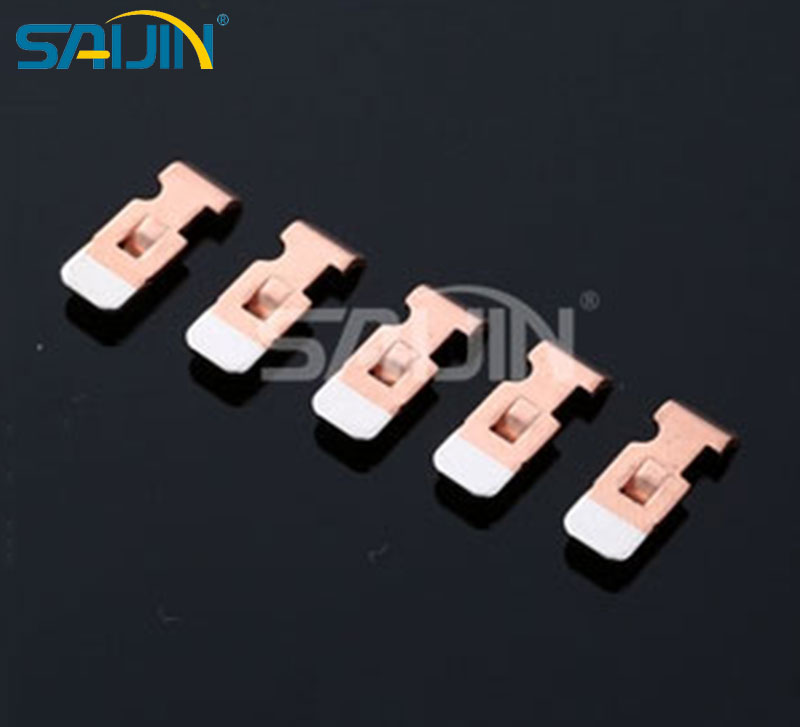
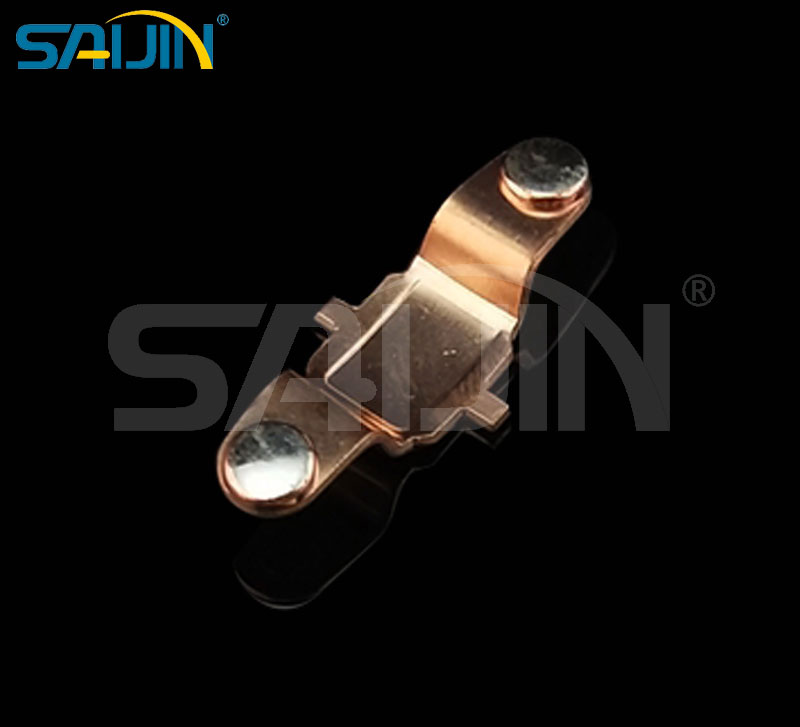
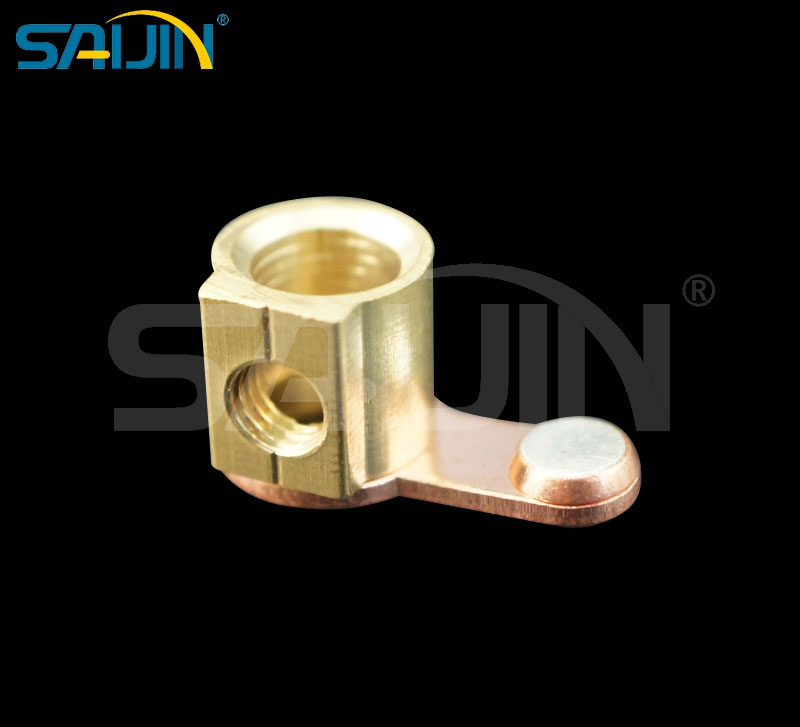
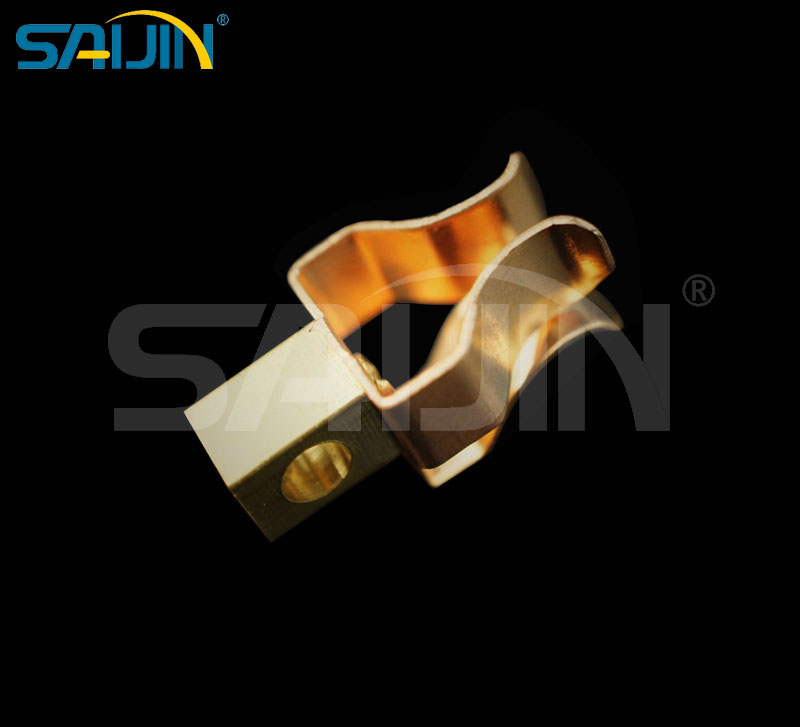
Contact assemblies (rivets pre‑mounted to copper arms)
-
Custom shapes for non‑standard relay designs
Powder‑metallurgy contacts from Saijin are used in plug‑in relays, PCB relays, automotive relays, contactors, micro switches, thermostats, limit switches, and manual motor starters.
For a powder‑metallurgy electrical contact points system that outlasts stamped alternatives, Saijin’s AgSnO₂, AgNi, and AgZnO compositions deliver application‑specific alloy selection, isotropic grain structure for crack resistance, ±0.02mm dimensional accuracy, five‑stage quality inspection, and RoHS/REACH compliance.
【Request a quote from Saijin Electric】
Send Saijin your switching load (voltage, current, AC or DC), the number of cycles you need, and the contact diameter. Saijin will recommend an alloy and provide sample rivets with a full inspection report.