China
China Pусский
 Español
 EN
ENWhy does a solid brass silver rivet contact outlast a bimetal design after 30,000 cycles?
A quality engineer at an industrial rocker switch manufacturer reviewed 100,000-cycle endurance test data for two batches of switches. Both batches used the same contact material combination on the movable and stationary rivets. The only difference was the rivet construction. One batch used a bimetal silver‑on‑copper rivet, economical and widely used in household appliances. The other used a silver rivet contact on a solid brass base. The bimetal rivets in the test fixture developed a gap between the silver head and the copper shank at 22,000 cycles. Contact resistance rose from 14mΩ to 34mΩ. The solid brass rivet batch completed 100,000 cycles with contact resistance staying below 15mΩ. The failure mode was not contact wear. It was the loss of mechanical integrity at the interface between the silver alloy layer and the copper substrate. When a bimetal rivet is cold‑headed, the bond between the silver and copper sections is metallurgical but thin, typically 5‑15 microns thick. Under thousands of switching cycles with electrical current, thermal expansion and contraction cycles stress this interface. The solid brass contact rivets from Saijin have no such interface at the rivet head. The entire rivet, including the head and shank, is formed from a single brass blank, then silver‑plated to the required thickness. This eliminates the layer‑to‑layer failure mode that bimetal rivets experience after extended thermal cycling.
| Property | Solid Brass Rivet (Saijin) | Bimetal Rivet (Ag on Cu) |
|---|---|---|
| Base material | Brass (single piece) | Copper with silver alloy bonded |
| Silver layer | ≥3μm electroplate | Cold‑bonded silver alloy head (1‑2mm thick) |
| Impact resistance | +40% vs bimetal design | Baseline |
| Contact resistance stability | 30,000‑100,000 cycles | 20,000‑50,000 cycles |
| Interface failure mode | None (no internal bond line) | Delamination at Ag‑Cu bond |
| Cost | Higher | Lower |
| Best for | High‑cycle, high‑vibration, automotive | Cost‑sensitive, moderate‑cycle appliances |
The brass rivet’s impact resistance is improved by 40% compared to conventional designs, directly from the absence of a bonded interface that can shear under shock loads from switch snap‑action mechanisms. For a rocker switch mounted on the dashboard of a forklift that sees continuous vibration, that difference can mean the difference between a switch that lasts ten years and one that fails in eighteen months.
The 3μm silver plating floor: why a solid brass rivet with thin silver outlasts a bimetal rivet with thick silver
At first glance, a bimetal rivet with a 1mm thick silver alloy head should outlast a plated solid brass rivet with only 0.003mm (3μm) of silver on its surface. The bimetal head has far more silver mass to erode away. But real‑world tests show the bimetal rivet often fails first, not because the silver wears out, but because the interface between the silver and copper fails.
The wear particles in a switch are not silver alone. They include copper oxides, tin oxides, and other contaminants that accumulate in the contact gap. In a solid brass rivet with a plated surface, when the silver wears through to the brass substrate, the contact resistance rises immediately, providing a clear failure signal. In a bimetal rivet, the silver alloy head can continue to erode and transfer material for many cycles after the bond line has weakened, producing a gradual and unpredictable resistance drift.
Saijin specifies a minimum silver plating thickness of 3μm for its solid brass contact rivets, with an optional 5μm coating available for extreme environmental applications. The electroplating process is precisely controlled with an automatic optical inspection system that verifies coating thickness across the entire head surface. For a rocker switch that will be used in a humid environment (kitchen appliances, outdoor power tools), the extra thickness provides a corrosion barrier for the brass substrate.
For applications where the switch is expected to operate in a salt‑air or industrial environment, Saijin offers a 5μm thick silver coating option, which extends the time before the brass substrate is exposed.
The cold‑heading advantage: how fully automated riveting delivers 0.02mm tolerance and 500,000‑cycle mechanical durability
The manufacturing process for solid brass contact rivets begins with brass wire rod, cut into slugs of precise length, then cold‑headed in high‑speed automatic rivet presses. Cold‑heading is a metal forming process that reshapes the slug by striking it with a die at room temperature. The process work‑hardens the brass, increasing its yield strength by 15‑20% compared to machined or cast parts. The result is a contact rivet with impact resistance improved by 40% over conventional designs.
Saijin’s production line for silver rivet contacts maintains tolerance accuracy of ±0.02mm across all dimensions, the head diameter, shank diameter, total length, and head thickness. This tolerance stack is critical for automated switch assembly. A rivet shank that is 0.05mm too large will not insert into the contact arm. A head that is 0.03mm too thick will change the contact gap, affecting the switch’s make‑and‑break characteristics.
The company’s fully automated riveting equipment runs with 99.99% process consistency. Each rivet is inspected by automated optical equipment capable of three‑dimensional morphology restoration, rejecting any part that deviates from the design drawing. The end product passes a 500,000‑cycle insertion and extraction life test and operates in temperatures ranging from ‑40°C to 150°C.
Why the shank length matters for the riveting process in switch assembly
When a solid brass rivet is inserted into the switch contact arm, the shank must extend beyond the arm by the correct amount, typically 0.5‑1.0mm, before the upsetting tool forms the rivet head on the far side. If the shank is too short, the upsetting tool does not form a full head, and the rivet loosens over time. If the shank is too long, the excess material can interfere with adjacent contact arms or increase the contact resistance path. Saijin’s engineers provide a dimensional drawing with each quote, specifying the shank length tolerance of ±0.02mm.
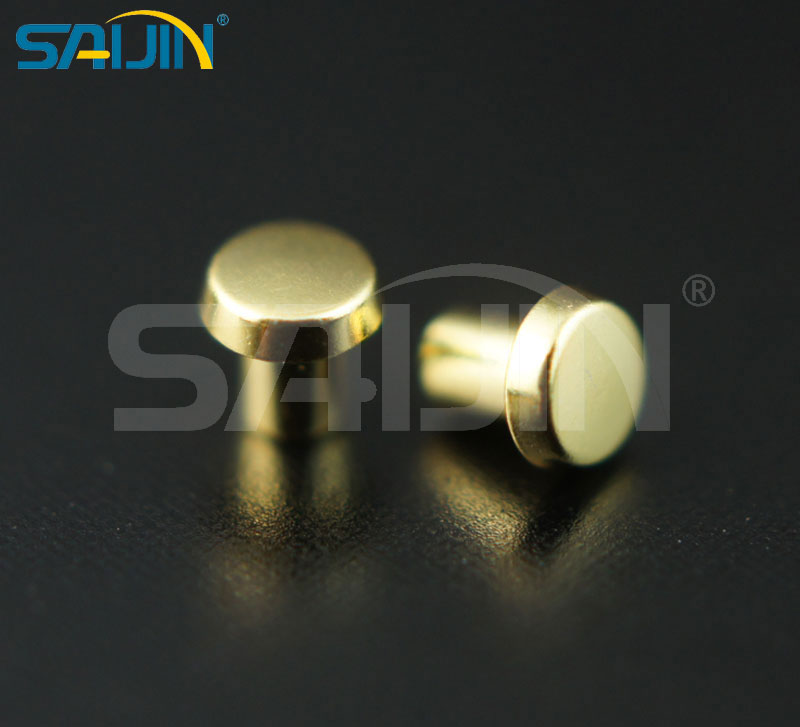
From 10A to 40A: how the head diameter and silver thickness determine the current rating of a switch
A rocker switch manufacturer asked Saijin for a contact rivet rated for 25A AC at 250V. The switch had tight space constraints and could only accommodate a 4.0mm head diameter versus the 5.0mm head that might be typical for that current. The challenge was to fit 25A through a head diameter smaller than the industry rule of thumb.
The calculation used by Saijin’s material engineers: determine the cross‑sectional area of the rivet head’s contact footprint, estimate the current density based on the silver material limits, then adjust the silver plating thickness to provide a margin for arc erosion. The final specification was 4.0mm head diameter, 5μm silver plating (thicker than the standard 3μm), and an AgNi alloy electroplated onto the contact surface rather than pure silver.
| Current Rating | Minimum Head Diameter | Recommended Plating | Typical Application |
|---|---|---|---|
| 5‑10A | 2.5‑3.0mm | 3μm Ag | Power tool switches, appliance door interlocks |
| 10‑20A | 3.0‑4.0mm | 3‑5μm Ag | Industrial rocker switches, control panels |
| 20‑30A | 4.0‑5.0mm | 5μm AgNi | High‑current circuit breakers, motor contactors |
| 30‑40A | 5.0‑6.0mm | 5‑7μm AgNi or AgSnO₂ | Automotive battery disconnects, heavy‑duty contactors |
A 3.0mm head diameter, as commonly used for 20‑30A rated switches, must be evaluated for its specific current load. If the design requires 30A switching with a limited head diameter, the silver alloy type matters more than the plating thickness, AgSnInO₂(14.5) has better resistance to arc erosion and is preferred for high‑current and high‑temperature applications.
Three data points that tell you a contact rivet is failing before the switch stops working
Indicator one: Contact resistance creep beyond 25% of initial value
During qualification testing, a consistent measurement reading is observed. After 15,000 cycles at full load, contact resistance has risen from the low milliohm range to a significantly higher value. The switch still operates, and the mechanical click feels normal. The performance degradation is irreversible. The internal wear debris is accumulating in the contact gap, reducing the effective contact area. Saijin’s testing data shows that for solid brass rivets with ≥3μm silver plating, the resistance increase is less than 10% over the first 50,000 cycles under rated load. A resistance increase of 25% or more at 50% of the expected life indicates either insufficient plating thickness or a base metal unsuitable for the load.
Indicator two: Discoloration of the silver contact face
A white or gray film on the silver contact surface is silver sulfide or silver oxide, formed by reaction with sulfur compounds in the air. This film is conductive but less than pure silver. A black or brown spot indicates carbonization from arcing; this deposit is non‑conductive and causes intermittent switching. A switch disassembly that reveals a brown spot at the same location on every opening cycle means the arc suppression design needs improvement, not the contact material.
Indicator three: Loosening of the rivet in the contact arm
A switch that passed initial torque testing but developed intermittent connection after thermal cycling may have a rivet that has loosened. The brass shank has a lower coefficient of thermal expansion than copper, and repeated heating and cooling cycles can loosen the rivet fit if the assembly did not use adequate upsetting force. Saijin’s cold‑headed rivets are formed with controlled upsetting pressure, and the company provides a recommended riveting force specification to their customers.
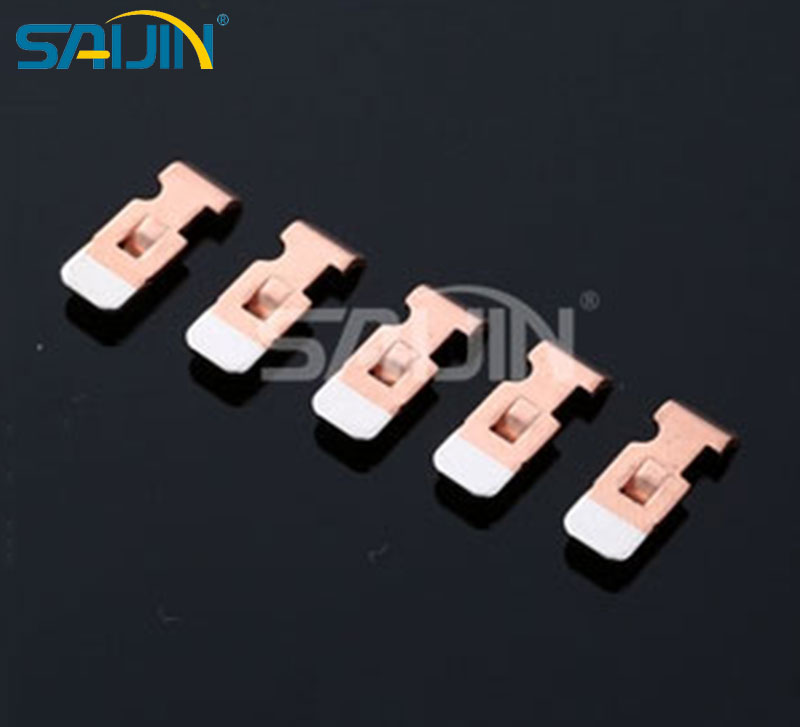
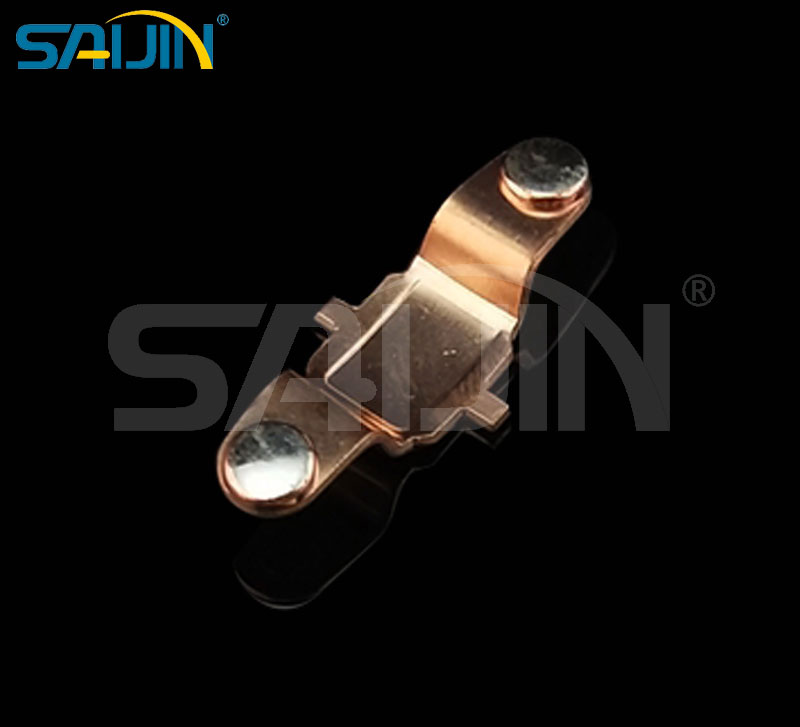
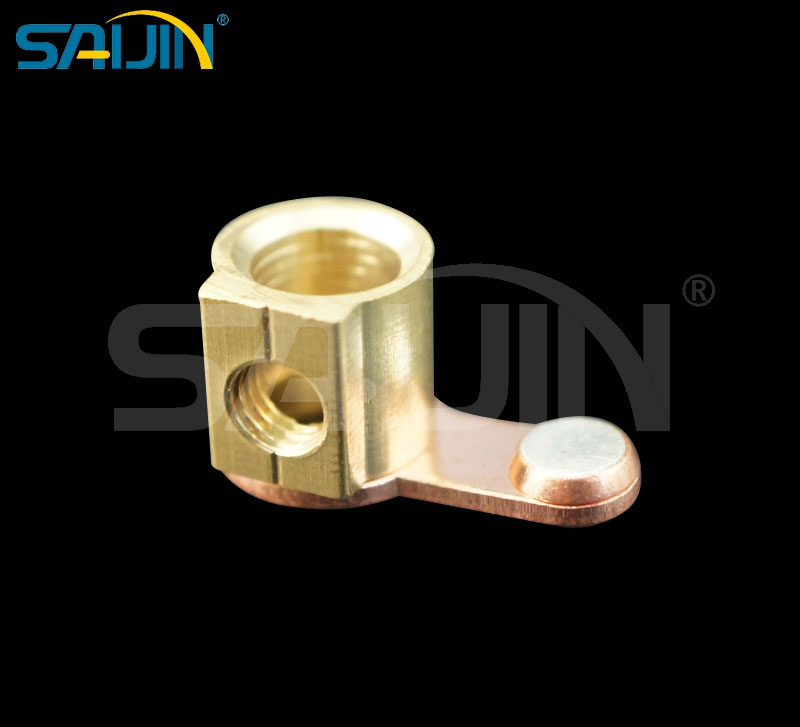
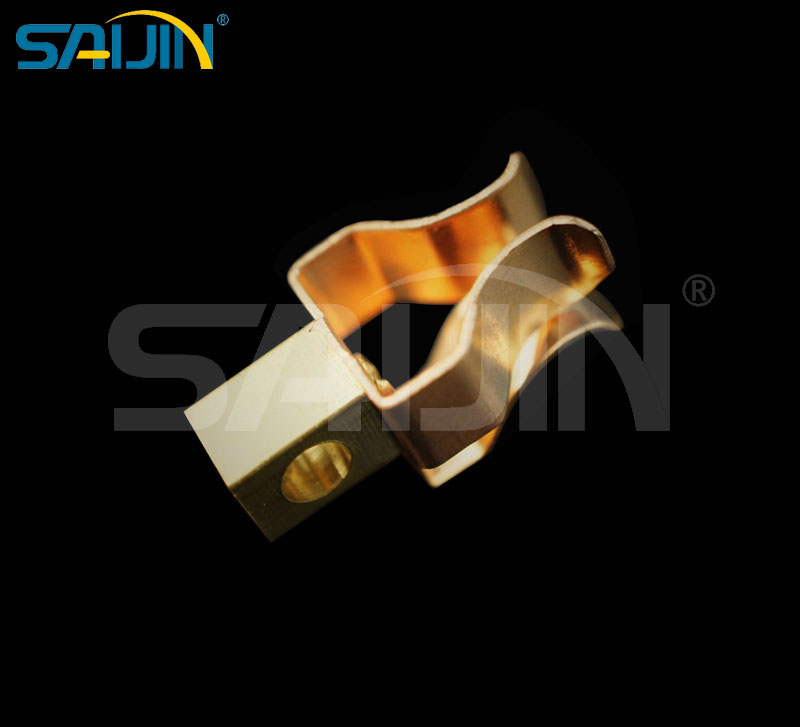
[Image: Saijin solid brass contact rivet mounted on a rocker switch contact arm, showing the fully formed upset head on the reverse side and the precision‑machined contact surface]
How Saijin’s electrical Rocker Switch Solid Brass Contact Rivets fit into switch and relay manufacturing
Saijin has specialized in the production of electrical silver rivet contacts for nearly thirty years, serving switch, relay, circuit breaker, and thermostat manufacturers. The company’s brass contact rivet line is distinguished by its fully solid structure design with no bonded interfaces that can fail under thermal cycling, impact resistance increased by 40% compared to bimetal designs, silver plating thickness of ≥3μm (with an optional 5μm for extreme environments), cold‑heading manufacturing for high strength, IATF 16949 certification for automotive applications, and RoHS and REACH compliance.
The company’s engineering team provides design support for non‑specialized sizes, shaped structures, and special functional requirements, including multi‑contact integration and miniaturization. Standard tooling lead time for new rivet sizes is minimal, and material composition can be customized between pure silver, AgNi, and AgSnO₂ depending on the switching load and arc environment.
For a silver rivet contact that eliminates the interface failure mode of bimetal designs, survives 100,000 mechanical cycles with stable contact resistance, and delivers 40% higher impact resistance, Saijin’s electrical Rocker Switch Solid Brass Contact Rivets are engineered for industrial switches, automotive rocker switches, high‑cycle contactors, and circuit breaker auxiliary contacts.
[Request a quote from Saijin Electric]
Contact Saijin Electric with your switching current (A), load type (resistive, inductive, lamp), head diameter (2.5‑8.0mm), and estimated annual volume for a solid brass contact rivet drawing and price.