China
China Pусский
 Español
 EN
ENWhy does a silver rivet contact with AgSnO₂ face survive twice as many switching cycles as a pure silver contact in a 32A AC load?
A relay manufacturer testing a 32A AC load ran two contact materials side-by-side. A pure fine‑silver rivet head welded closed at 48,000 cycles. A silver‑cadmium oxide (AgCdO) bimetal contact failed at 52,000 cycles. A silver rivet contact made with silver‑tin oxide (AgSnO₂) on the same copper shank assembly continued switching past 100,000 cycles. The contact faces showed uniform arc erosion but no weld marks, and the contact resistance stayed below 0.5 mΩ throughout the test.
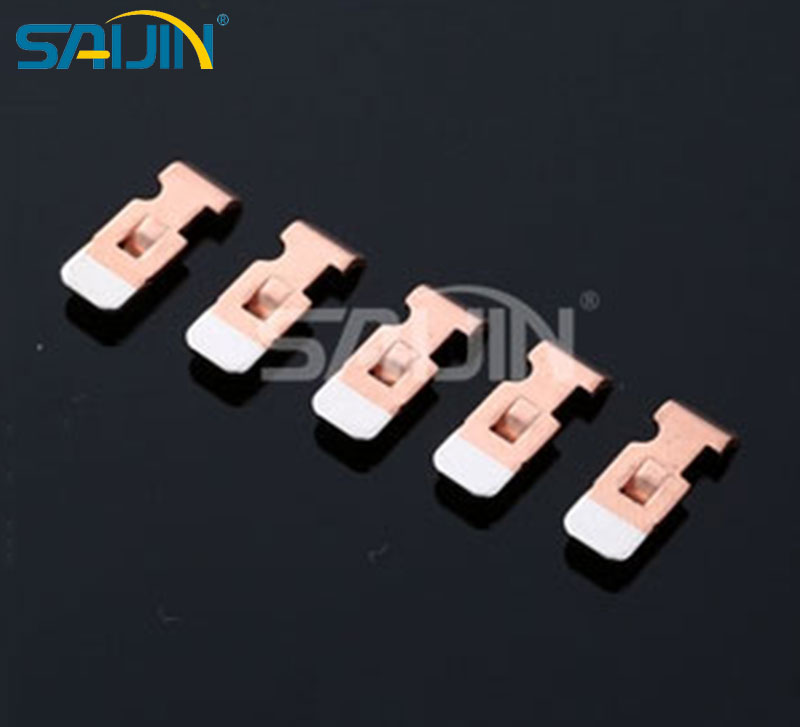
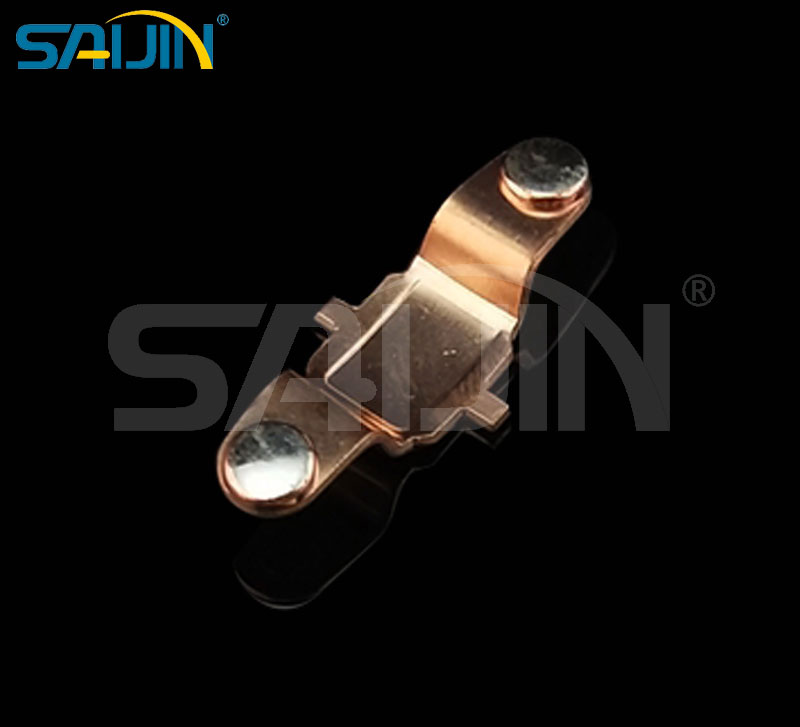
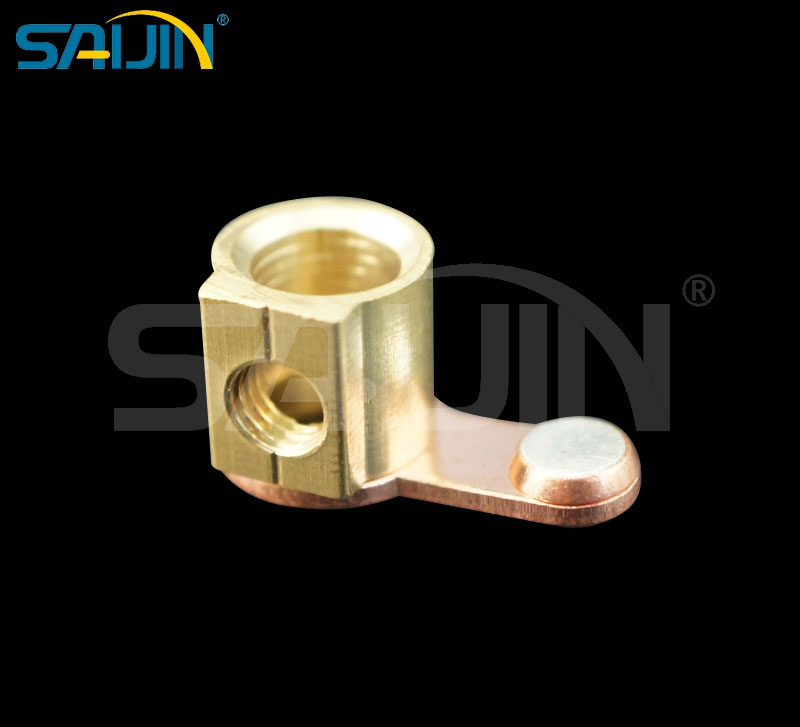
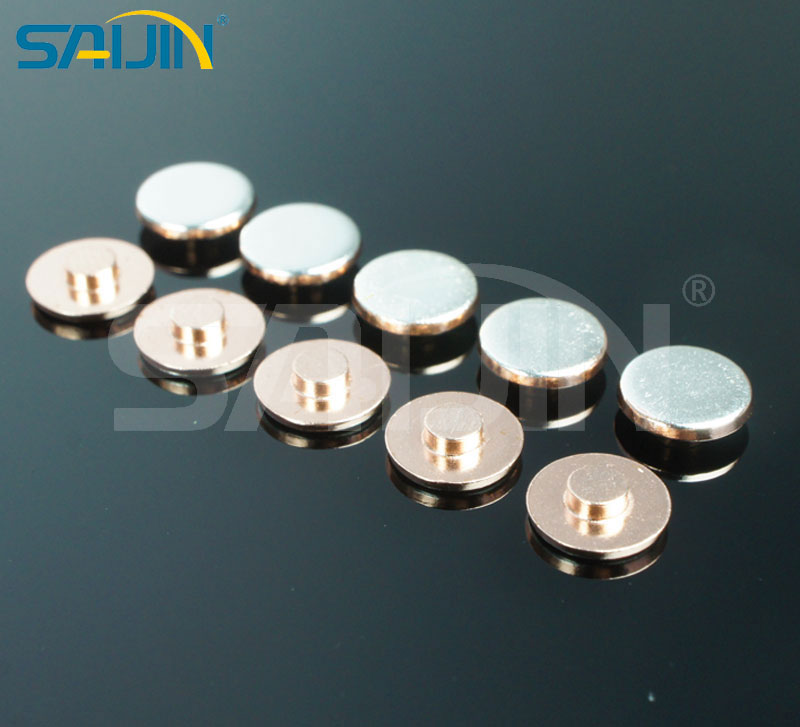
A silver rivet contact is a pressed or cold‑headed electrical contact component consisting of a silver‑alloy head (the working face that makes and breaks the circuit) and a copper or brass shank (for crimping or welding into the contact arm). The Electrical Relay Silver AgSnO₂/Cu Bimetal Rivets from Saijin Electric combine the arc‑erosion resistance of tin‑oxide‑dispersed silver with the conductivity and mechanical strength of a pure copper base. This guide explains why AgSnO₂ outlasts AgCdO in AC contactors, how the bimetal rivet’s shank diameter and head thickness affect heat dissipation, where the 1.0 mm silver layer specification fits into a 30A relay design, and the material certification stack that qualifies these rivets for export to European and North American markets.
AgSnO₂ vs AgCdO: why the tin‑oxide material wins the arc‑erosion battle in modern contactors
For decades, silver‑cadmium oxide (AgCdO) was the standard contact material for medium‑ and high‑current relays and contactors. Cadmium oxide is highly effective at reducing arc erosion. However, cadmium is a restricted hazardous substance under the EU’s RoHS directive, and many OEMs have phased it out entirely. The search for a RoHS‑compliant, non‑toxic substitute led to silver‑tin oxide (AgSnO₂).
Silver rivet contact heads made of AgSnO₂ contain 10‑15% SnO₂ particles distributed throughout the silver matrix. When an arc forms across the opening contacts, the tin oxide particles decompose and form a refractory layer on the contact surface. This layer is less conductive than silver, but it protects the underlying material from further erosion. The surface remains stable for hundreds of thousands of operations, with the arc energy being deflected rather than focused on a single melting spot.
| Contact Material | Arc Erosion Resistance | RoHS Compliance | Typical Applications |
|---|---|---|---|
| Pure fine silver (Ag) | Poor (welds easily) | Yes | Low‑current (≤5A), DC loads |
| Silver‑cadmium oxide (AgCdO) | Excellent (historical standard) | No (cadmium restricted) | Legacy relays, contactors |
| Silver‑tin oxide (AgSnO₂) | Excellent (superior at >20A) | Yes | Modern relays, contactors, starters |
| Silver‑nickel (AgNi) | Good | Yes | Moderate current (10‑30A), AC loads |
Under 32A AC load, AgSnO₂ exhibits a significantly lower temperature rise than AgCdO, and its anti‑arc erosion performance is measurably better according to multiple comparative studies. The failure mode is gradual contact erosion, not sudden welding, which allows predictive maintenance rather than catastrophic circuit failure.
Why the tin oxide particle size matters for high‑frequency switching
The SnO₂ particle size in Saijin’s material specification is controlled to between 1‑5 microns. If the particles are too large, the contact resistance rises; if they are too small, the particles do not adequately suppress arc erosion. The manufacturing process uses either internal oxidation of a silver‑tin alloy or powder metallurgy blending followed by pressing and sintering. Saijin’s process ensures a uniform dispersion of tin oxide, eliminating the agglomeration that can cause local hot spots during switching.
Bimetal rivet construction: why the copper shank carries the current while the silver head does the switching
A solid silver rivet would be expensive and mechanically weak for the shank portion. The rivet structure positions the silver‑alloy material exactly where it is needed: in the head, where the electrical contact opens and closes. The shank is pure copper, which has nearly the same conductivity as silver (100% IACS vs 105% IACS) but is substantially cheaper and less prone to deformation under crimping forces.
Saijin’s silver rivet contact is manufactured by cold‑heading a silver‑alloy wire and a copper wire simultaneously in a high‑speed rivet machine. The silver and copper sections are joined under extreme pressure in the die, creating a metallurgical bond without a separate brazing or welding step. The junction between the silver head and the copper shank has a tensile strength exceeding 200 MPa, sufficient to withstand the crimping forces of automated assembly machines.
| Parameter | Typical Value | Application Impact |
|---|---|---|
| Shank diameter (d) | 1.2‑8.0 mm | Defines current‑carrying capacity, assembly method |
| Head diameter (D) | 2.5‑10.0 mm | Determines contact area, arc‑energy dissipation |
| Head thickness (T) | 0.5‑2.0 mm | Silver layer thickness; thicker for higher current |
| Shank length (L) | 3.0‑12.0 mm | Sets insertion depth into contact arm |
| Silver alloy | AgSnO₂, AgNi, AgZnO, AgC | Selected based on load type (AC vs DC, inductive vs resistive) |
The head thickness for a bimetal rivet used in a 32A relay should be at least 1.0mm. A thinner head may overheat during sustained switching, and the heat can migrate down the shank and soften the copper, leading to a loose rivet after thousands of thermal cycles.
The press‑bonded interface: how the silver‑to‑copper junction withstands thermal cycling without delaminating
The interface between the silver alloy head and the copper shank is the most critical mechanical feature of a bimetal rivet. If the bond fails, the head can spin on the shank under crimping forces, or the electrical path through the joint can increase resistance, causing local heating.
Saijin’s manufacturing process for the silver rivet contact uses a press‑bonded technique performed on high‑speed cold‑heading equipment. The silver and copper wire segments are cut to precise lengths, aligned in the die, and then upset under controlled force. No intermediate brazing alloy is used; the bond is formed by the extreme pressure causing atomic diffusion across the silver‑copper interface.
The resulting bond line is typically 5‑15 microns thick, with interdiffusion of silver and copper across the interface. This bond has been tested to withstand thermal cycling from -40°C to 125°C for 1,000 cycles without measurable change in contact resistance. For applications where the rivet is welded into a contact arm (rather than crimped), the press‑bonded interface must survive the heat of the welding process without degrading. Saijin’s material specification includes a sample weld test to confirm that the silver alloy does not melt or separate from the shank during armature assembly.
From 15A to 80A: how the shank diameter and silver alloy choice change the current rating
A silver rivet contact is not a one‑size‑fits‑all component. The current rating depends on three factors: the shank diameter, the silver alloy composition, and the head thickness.
-
Shank diameter: The primary conduction path is through the copper shank. For 10‑15A applications, a 2.5‑3.0 mm shank is adequate. For 30‑50A relays, the shank diameter should be 4.0‑5.0 mm. For 60‑80A contactors, the shank diameter increases to 6.0‑8.0 mm. The industry rule of thumb for AC applications is approximately 1‑1.5 A per square millimetre of shank cross‑section.
-
Silver alloy composition: AgSnO₂ is required for currents above 25A AC to prevent arc welding. For DC loads above 50V, silver‑nickel (AgNi) offers higher resistance to material transfer (the “pip and crater” effect). For very low‑current dry circuits (e.g., signal switching below 100mA), a fine silver or gold‑plated contact is used to maintain low and stable contact resistance.
-
Head thickness: A 0.5mm head may overheat and melt at the surface after 50,000 cycles at 30A. For a 30A AC relay, a head thickness of 0.8‑1.0mm is recommended. For a 50A contactor, the head thickness should be 1.2‑1.5mm.
Saijin’s product range offers AgSnO₂ (12‑15% SnO₂ content) for AC switching above 20A, AgNi (10‑15% Ni) for DC and automotive applications, AgZnO for high‑current/low‑voltage DC (battery disconnects), and AgC (silver‑graphite) for applications where anti‑welding is more critical than low contact resistance (e.g., circuit breakers).
RoHS, REACH, and the material restrictions that drive the shift from AgCdO
The European Union’s RoHS Directive restricts the use of cadmium in electrical and electronic equipment. The maximum allowable concentration of cadmium is 0.01% (100 ppm) by weight in homogeneous materials. AgCdO contacts, which typically contain 10‑15% cadmium oxide, substantially exceed this limit.
For any relay or contactor manufacturer exporting to the EU, AgCdO is not an acceptable material. China, South Korea, and several other countries have enacted similar restrictions, making AgSnO₂ the global standard for new product designs.
Saijin offers AgSnO₂/Cu bimetal rivets that comply with EU RoHS (no cadmium, lead, mercury, hexavalent chromium, PBB, or PBDE) and REACH (registration of SVHC substances). The certificates are available for customer documentation. The company also confirms that its silver alloy materials contain no intentionally added cadmium or lead, and the purity of the electro‑plated tin on the shank (if specified) meets the 0.1% lead exemption for certain categories. For a component engineer selecting a contact for a new global product, the RoHS compliance of Saijin’s AgSnO₂ rivets eliminates the need for regional material variants.
Quality controls that catch a loose grain of tin oxide before it becomes a weld
A single oversized tin oxide particle in the silver head can act as a current concentration point, causing local melting and initiating a weld during the first few switching cycles. Saijin’s incoming material inspection includes microscopic examination of the silver alloy’s microstructure, ensuring the SnO₂ particles are uniformly dispersed and of the specified size.
In‑process inspections include:
-
Shank diameter: Automatic contact detection equipment verifies shank diameter to ±0.03mm, preventing jams in automated relay assembly fixtures.
-
Head diameter and thickness: Projection detection systems compare the rivet’s geometry against the drawing, rejecting components where the head is off‑center or the thickness varies.
-
Surface roughness: The silver head face is specified at a smoothness of 0.8‑1.2 μm Ra. A rougher surface has a higher initial contact resistance and may arc weld prematurely.
-
Hardness testing: The hardness of the silver alloy is tested to ensure it falls within the specified range, which indicates proper sintering and heat treatment.
The finished rivets are batch‑tested for electrical resistance in a simulated relay fixture. The test applies a 20‑50A AC current and measures the voltage drop across the rivet, converting it to contact resistance. A silver rivet contact that shows a resistance above 0.5 mΩ is rejected, as is a rivet whose resistance fluctuates when the test load is cycled—an indication of a loose press bond between the silver head and copper shank.
[Image: Saijin production line showing automatic contact detection equipment, projection measurement system, and batch resistance testing setup for silver rivet contacts]
Three ways a relay engineer uses Saijin’s bimetal rivet specs to predict contact life
One: Match the head diameter to the switching current
The head diameter determines the area over which the arc energy is dissipated. For a 10A AC relay, a 3.0‑3.5mm head diameter is sufficient; for a 32A contactor, the head diameter should be 5.0‑6.0mm. A head that is too small concentrates the arc energy, accelerating erosion; a head that is too large adds unnecessary inductance and cost.
Two: Specify the correct silver alloy for the load type
-
AgSnO₂: AC resistive and inductive loads above 15A.
-
AgNi: DC loads (battery circuits, DC motors) where material transfer is the primary wear mechanism.
-
AgZnO: High‑current DC (>60A) applications such as battery disconnects.
-
AgC: Circuit breakers where anti‑welding is critical (silver‑graphite has poor conductivity but resists welding).
Three: Verify the shank length before ordering
The shank length must match the thickness of the contact arm into which the rivet is crimped or welded. A shank that is 0.5mm too short can cause the contact arm to lack sufficient mechanical support, causing the rivet to tilt after clamping. A shank that is 2mm too long may protrude beyond the arm, increasing inductance and potentially causing a short to adjacent components. Saijin’s technical support team can recommend shank lengths based on the customer’s armature drawing.
How the Electrical Relay Silver AgSnO₂/Cu Bimetal Rivets fit into Saijin’s contact product line
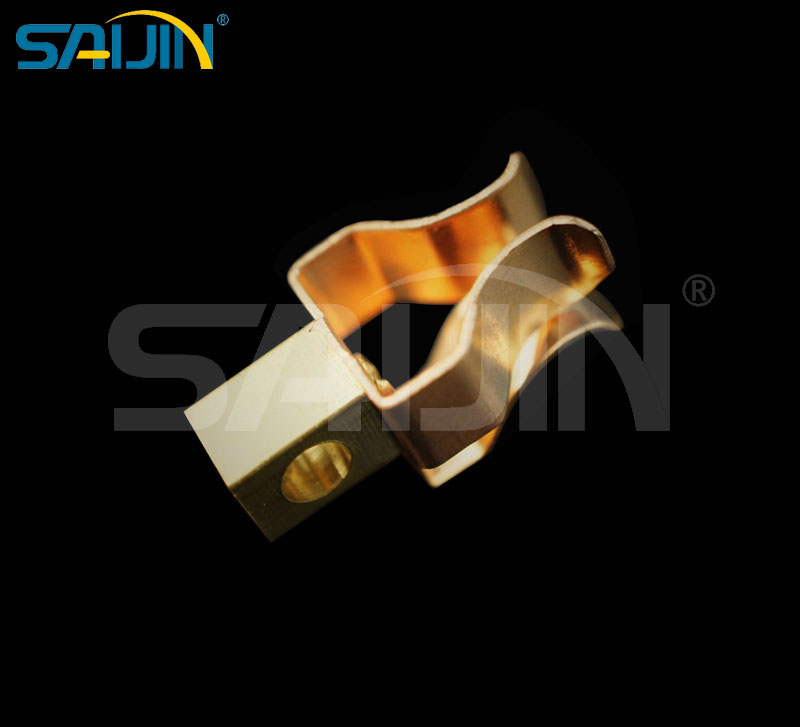
Wenzhou Saijin Electric Alloy Co., Ltd. (Saijin) has manufactured electrical contacts for over 20 years. The product range includes: AgSnO₂/Cu bimetal rivets (the subject of this guide), AgNi/Cu bimetal rivets (for DC automotive relays), solid fine‑silver rivets (for low‑current signal switching), trimetal AgSnO₂/Ag/Cu rivets (where a pure silver interlayer improves the press bond), and contact assemblies (rivets pre‑mounted to copper contact arms).
Saijin holds ISO 9001:2015 certification for quality management, ensuring that each production batch is traceable to raw material mill certificates. The company uses 5S lean manufacturing practices and maintains separate production lines for RoHS‑compliant and non‑RoHS materials to prevent cross‑contamination. For customers requiring UL recognition or specific automotive (IATF 16949) certifications, Saijin’s sales team can provide documentation or coordinate third‑party testing.
For a silver rivet contact that outlasts AgCdO by 2x in 32A AC switching, conforms to RoHS and REACH, and offers AgSnO₂ arc‑erosion resistance combined with the conductivity of a pure copper shank, Saijin’s Electrical Relay Silver AgSnO₂/Cu Bimetal Rivets are designed for modern relays, contactors, and switches.
[Request a quote from Saijin Electric]
Contact Saijin with your switching load (voltage, current, AC/DC), required rivet head diameter, and shank length for an AgSnO₂/Cu bimetal rivet quotation and sample package.