China
China Pусский
 Español
 EN
ENWhy Choose Tungsten Rivets for Electrical Contacts?
You're specifying electrical contacts for a new relay design. The switching frequency is high—thousands of operations per day. The current is significant. The environment isn't kind. Copper contacts would pit and weld. Silver would oxidize. You need something that can take the heat—literally.
A tungsten rivet is a small component with a big responsibility. It's the point where electrical current is made and broken, sometimes thousands of times a day. If it fails, the whole device fails. Tungsten's unique combination of properties—extreme hardness, arc resistance, and high-temperature stability—makes it the material of choice for demanding electrical contact applications. This guide covers what makes tungsten rivets different, where they're used, and what to look for when specifying them for your next project.
What makes tungsten the right material for contacts
Tungsten isn't cheap, and it isn't easy to work with. But for electrical contacts, its properties are unmatched by any other common metal.
The melting point that handles the heat
Tungsten has the highest melting point of any metal—3410°C. When a contact opens under load, an arc forms. That arc can reach temperatures that would melt copper or silver instantly. Tungsten doesn't melt. It doesn't soften. It maintains its shape and function through thousands of switching cycles.
For applications where high temperatures are routine—automotive engine compartments, industrial switchgear, high-load relays—tungsten's thermal stability isn't optional. It's essential.
Arc resistance that prevents contact welding
When contacts separate under load, the arc erodes the contact surface. Over time, this erosion changes the contact geometry and increases resistance. Tungsten's arc resistance is exceptional. It doesn't transfer metal from one contact to the other the way softer metals do. This means less welding, less pitting, and longer service life.
Hardness that resists mechanical wear
Tungsten is extremely hard—up to 680 HV. In high-frequency switching applications, the contacts impact each other thousands of times per hour. Softer metals deform and wear, changing the contact geometry and eventually failing. Tungsten stays in spec. It resists the mechanical wear that kills other contacts.
Lower resistance in the contact zone
The Tungsten points are arc resistant, refractory, with less current consumption when the metal contact on surface. It has strong on-off current capability, good wear properties and dynamic performance. And interestingly, it's cheaper than any other metal or alloy material for this application.
Where tungsten rivets are used
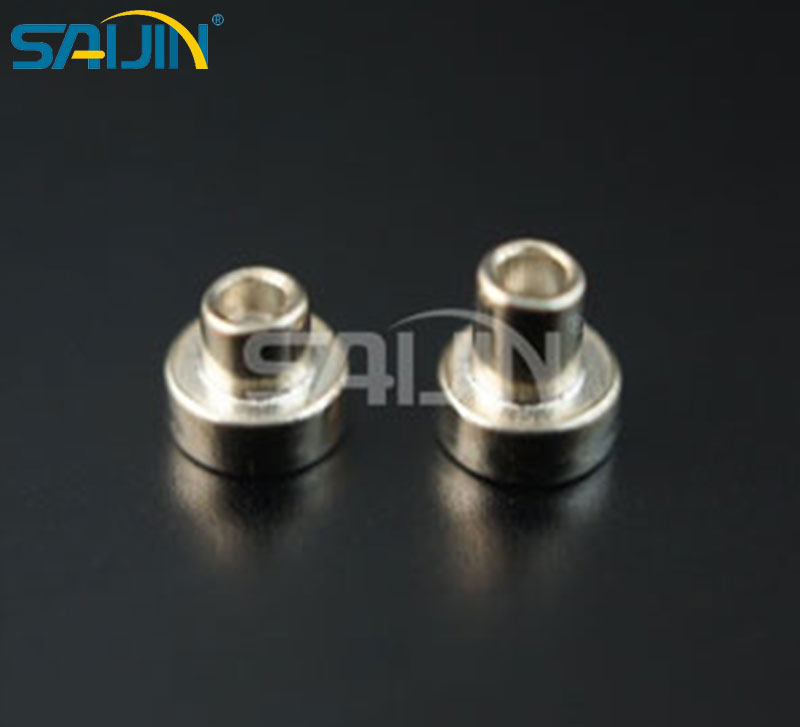
Tungsten rivets show up in applications where other contacts would fail. The half hollow shank design is particularly common in automated assembly environments.
Automotive and motorcycle horns
Automotive horns are one of the most demanding contact applications. They switch high current at high frequency, with the contacts opening and closing dozens of times each time the horn is pressed. Tungsten rivets are standard in both automotive and motorcycle horns. The rivet-type contacts can be processed in continuous automated production lines.
Relays and contactors
Relays and contactors need contacts that can handle frequent switching without degrading. Tungsten-silver alloys are used in lower voltage circuit breakers, automatic switches, and contactors that require good oxidation resistance, higher thermal conductivity, smaller contact size, and frequent opening and closing operations. Tungsten rivets provide the durability that these applications require.
Circuit breakers and switches
Circuit breakers and switches need contacts that can interrupt fault currents without welding. Tungsten's arc resistance makes it ideal for these applications. The contacts are designed to provide stable and efficient electrical connection points.
Battery management systems and EV applications
Half-hollow tungsten contact rivets ensure ultra-stable electrical connections in battery modules, enabling precise BMS voltage monitoring, enhanced thermal safety, and long-term reliability—critical for high-performance systems like EVs and grid storage. For the growing EV market, contact reliability is non-negotiable.
Small appliances and 3C devices
Riveted tungsten contacts are widely used in communications relays, small appliances, 3C appliances, traditional breaking switches, and various types of switches. The rivet-type contacts offer lower cost, low resistance, easier processing, and wide application.
Below is a quick reference table for tungsten rivet properties:
| Property | Value | Why It Matters |
|---|---|---|
| Material purity | ≥99.95% W | Consistent performance |
| Hardness | 680 HV | Resists mechanical wear |
| Density | ≥19.0 g/cm³ | Dense, durable contact |
| Grain count | 10,000-20,000 PCS/mm² | Fine, uniform grain structure |
| Melting point | 3410°C | Withstands arc heat |
| Shank diameter | 1.5mm - 3.0mm | Multiple sizes available |
| Tolerances | ±0.10mm (head), ±0.15mm (length) | Precision fits |
The half hollow shank advantage
The half hollow shank design isn't accidental. It's engineered for specific assembly and performance requirements.
Automated assembly compatibility
Rivet-type tungsten contacts are processed by riveting, enabling continuous automated production. The half hollow shank allows the rivet to deform during installation, creating a secure mechanical and electrical connection without welding or soldering.
Material efficiency
The hollow shank uses less tungsten than a solid shank of the same diameter, reducing material cost without sacrificing performance. The tungsten contact is typically combined with a copper or iron shank for improved conductivity and easier riveting.
Customizable dimensions
Tungsten rivets are available in a range of standard sizes, with customization available. Shank diameters from 1.5mm to 3.0mm, head diameters from 3mm to 6mm, and shank lengths from 1.5mm to 3.0mm cover most common applications.
Questions electrical component buyers ask
Q: How do tungsten rivets compare to silver or copper contacts?
A: Silver and copper have better conductivity but much lower hardness and melting points. They work well for low-load, low-frequency applications. For high-load, high-frequency, or high-temperature applications, tungsten's arc resistance and hardness make it the better choice. Tungsten-silver alloys offer a compromise—better conductivity than pure tungsten with improved arc resistance over pure silver.
Q: What tungsten content should I specify?
A: High-purity tungsten (≥99.95%) is used for the contact surface. The tungsten content is a critical factor, typically ranging from 50% to 90% in alloyed contacts. Higher tungsten content means better arc resistance and hardness but lower conductivity. The right balance depends on your application—higher tungsten for severe switching duty, higher silver or copper for conductivity-sensitive applications.
Q: Can tungsten rivets be used in DC applications?
A: Yes. Tungsten rivets are widely used in DC applications, including automotive horns, relays, and battery management systems. DC arcs are harder to extinguish than AC arcs because the current doesn't cross zero. Tungsten's arc resistance makes it particularly valuable in DC switching applications where other materials would fail.
Q: What is the typical lifespan of a tungsten rivet contact?
A: Service life depends on load, switching frequency, and environmental conditions. In automotive horn applications, tungsten contacts typically last the life of the vehicle. In high-frequency relay applications, the mechanical life of the relay often exceeds 1 million cycles. The combination of high hardness and arc resistance gives tungsten rivets a lifespan that far exceeds silver or copper contacts in demanding applications.
How to specify tungsten rivets for your application
Getting the right tungsten rivet starts with understanding your application requirements.
Define your electrical load
Current rating, voltage, and switching frequency determine the contact size and material. Higher loads require larger contact areas and higher tungsten content. For severe duty applications like automotive horns, high-purity tungsten is the standard.
[Consider the assembly method
Rivet-type contacts are designed for mechanical riveting. If your assembly process uses welding, you may need a different contact type. The half hollow shank is specifically designed for riveting applications.
Specify dimensions and tolerances
Standard dimensions include shank diameters from 1.5mm to 3.0mm and head diameters from 3mm to 6mm. Tolerances are typically ±0.10mm for head diameter and ±0.15mm for shank length. Custom dimensions are available.
Request samples and test
The only way to know if a tungsten rivet works in your application is to test it. Request samples and run them through your standard assembly and testing process. Verify pull-out force, contact resistance, and switching performance.
Need tungsten rivets for your next project? Contact a tungsten contact supplier for samples or a quote on half hollow shank tungsten contacts. Share your application type, electrical load, and dimensional requirements—their team can recommend the right tungsten rivet configuration for your specific application.