China
China Pусский
 Español
 EN
ENWhy Does Your Silver Rivet Contact Fail Early?
A 250 A AC contactor in a manufacturing plant chatters. The relay controlling a motor starter fails to pull in. A technician pulls the contactor cover and sees the silver alloy contact surface—pitted, cratered, and covered with black deposit. The Silver Rivet Contact has failed, and the entire device must be rebuilt.
These small riveted contacts—known as silver cadmium oxide (AgCdO) contacts—are standard in low‑voltage switching devices because they combine good anti‑welding properties, arc erosion resistance, and fairly low contact resistance over their service life. But AgCdO contacts fail in predictable ways. When the cadmium oxide evaporates, the contact loses its anti‑welding protection. When arcing pits the surface beyond a critical depth, contact resistance rises. When the copper base corrodes, the mechanical bond weakens. This guide explains how these electrical contact rivets work, the five most common field failure modes, and how to diagnose a failing AgCdO contact before the entire device fails.
What makes cadmium oxide the secret to arc resistance
Silver cadmium oxide electrical contact rivets offer excellent arc erosion resistance and low contact resistance, widely used in power switches, relays, and other low‑voltage switching devices. Pure silver has the highest electrical conductivity of all metals and the lowest contact resistance. But pure silver contacts weld together easily under high inrush current. Adding cadmium oxide (CdO) solves this problem.
When an arc strikes the contact surface, cadmium oxide decomposes violently at around 900°C, absorbing heat and releasing gas. This decomposition and evaporation interrupt the arc and cool the contact surface, preventing the silver from melting and welding to the opposite contact. The CdO particles also improve arc erosion resistance because cadmium oxide is an excellent arc extinguishing agent.
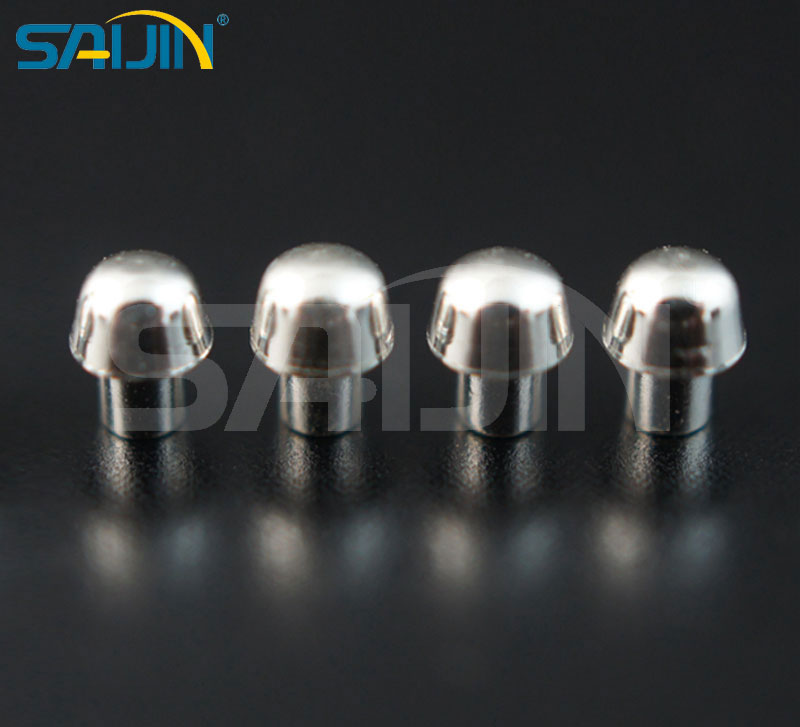
The Silver Rivet Contact is produced using the inner oxidation (I.O.) process or the atomizing‑sintering‑extrusion (ASE) process, resulting in fine, uniformly dispersed CdO particles. The fully solid structure design improves impact resistance by 40% with silver plating thickness ≥ 3 μm, supporting high current transmission in relays, contactors, high‑voltage switches, circuit breakers, and other low‑voltage apparatus.
Why silver‑based alloy outperforms copper
Unlike copper or brass contacts, silver remains conductive even when tarnished. Copper oxide is an insulator; silver oxide remains conductive. This makes AgCdO contacts more reliable in humid or corrosive environments, provided the copper base material is adequately protected.
Five ways a silver‑based switching contact gives out in the field
AgCdO contact rivets fail in five distinct patterns, each pointing to a different root cause. Recognizing the pattern helps you decide whether to replace just the contact, adjust the application, or change the material specification entirely.
When the anti‑weld ingredient runs out
AgCdO contacts gradually lose cadmium oxide over thousands of switching cycles. As CdO evaporates under repeated arcing, the contact surface becomes enriched in silver. The anti‑welding property degrades, and the contact becomes more prone to welding.
How to diagnose. Compare a new contact to a worn contact from a similar device. If the worn surface appears smoother, shinier, or less “textured” than a new AgCdO contact, significant CdO depletion has occurred. Measure the head thickness loss; once erosion exceeds 0.3 mm, the contact is at the end of its service life.
When to replace. For contactors in heavy‑duty motor control (100–200 switching cycles per day), inspect AgCdO contacts annually. Replace when pitting depth reaches 0.3 mm or when the silver layer has worn through to the copper base. In equipment where anti‑welding properties are critical (capacitor switching, high‑inrush transformers), replace earlier at 0.2 mm erosion.
Too much current, too many times – the heat damage pattern
When the contact carries current beyond its rating, heat builds up. The silver alloy may soften and flow, deforming the head shape. In extreme cases, the contact can melt and fuse to the stationary contact.
What to look for. Visible deformation of the contact head; a mushroomed or flattened appearance; silver material transferred to the stationary contact surface. The surrounding plastic may show heat discoloration.
Root cause. The contactor or relay was undersized for the load. For motor loads, inrush current can be 5–6× the running current. An AgCdO contact rivet rated for 30 A continuous may fail in months switching a 30 A motor that draws 180 A during start‑up.
Field fix. Replace the failed contact with the same AgCdO grade but also verify the device’s rating against actual load current. For high‑inrush applications, consider switching to an AgSnO₂ contact rivet, which offers better welding resistance at high current.
Green corrosion that eats the foundation
The rivet’s copper base is designed to hold the silver alloy head in place. Copper oxidizes and corrodes in humid or polluted environments. If the copper shank corrodes, the mechanical bond weakens, and the entire contact can loosen or fall out of the carrier.
What to look for. Green or black corrosion visible at the base of the rivet or on the copper carrier. The contact may feel loose when probed.
Prevention. Specify AgCdO contacts with electroplated nickel or tin barrier layer between the silver alloy and copper base. In coastal or chemical plant environments, sealed devices or conformal coating on the contact carrier reduce moisture ingress. Saijin offers AgCdO/Cu/AgCdO tri‑metal rivets, where the copper core is fully clad with silver alloy on both ends, eliminating copper exposure.
When the contact simply wears away
Every switching operation removes a small amount of contact material. Over the contact’s electrical life—typically 50,000 to 200,000 operations for AgCdO contacts—the head thickness decreases and the surface becomes pitted.
When to replace. The contact has reached its electrical life. Replace the entire contact set. AgCdO materials typically achieve resistivity ≤ 2.30 μΩ·cm and hardness ≥ 690 MPa, but after heavy arc erosion, both properties degrade. Use a micrometer to measure remaining head thickness against the manufacturer‘s minimum specification.
Service life. For a contactor in a motor control center cycling 500 times per day, a 150,000‑operation AgCdO contact will last 300 days. Track switching cycles in a maintenance log; replace contacts proactively at 80% of rated electrical life.
Dirt and grease that won‘t wipe off
Contamination on the contact surface increases resistance, generates heat, and accelerates arc erosion.
What to look for. Black, crusty deposits that do not wipe off with isopropyl alcohol; a sticky or tacky feel to the contact surface.
Common sources. Silicone‑based lubricants in the device mechanism outgas and deposit on contacts. Dust from manufacturing or installation carries conductive particles. Finger oils from handling during assembly.
Remediation. Clean light contamination with 98% isopropyl alcohol and a lint‑free swab. Do not abrade or file the contact surface—removing silver alloy shortens the contact’s life. For severe contamination, replace the contact.
A five‑minute inspection that saves a full rebuild
A systematic inspection of the failed contact rivet takes five minutes and requires only a magnifier and a micrometer.
Step 1 – Visual inspection. Examine the contact head under 5–10× magnification. Look for pitting, cratering, material transfer (pip and crater pattern), or a smooth, shiny surface (indicating CdO depletion). Green or black corrosion on the copper base indicates moisture ingress.
Step 2 – Thickness measurement. Use a micrometer to measure the remaining head thickness. Compare to the original specification (typically available from the contact supplier). If erosion exceeds 0.3 mm, the contact is at the end of its electrical life. For AgCdO materials rated at 2.30 μΩ·cm resistivity, exceeding that value by more than 10% is also a replacement indicator.
Step 3 – Check the mating stationary contact. If one contact shows severe pitting, the stationary contact may also be damaged. Replace contact pairs, not single contacts, to ensure matched wear patterns.
Step 4 – Verify the application. If the same contact fails repeatedly in the same device, the contactor or relay may be undersized, or the ambient environment may be corrosive. Consider upgrading to a higher‑rated AgCdO grade (e.g., from AgCdO 10 to AgCdO 12 or 15) or switching to a different contact alloy such as AgSnO₂.
What shop floor veterans ask about contact rivets
Q: Can I mix AgCdO contacts from different manufacturers? A: Not recommended. Even if the nominal alloy composition is the same, different manufacturing processes (inner oxidation vs. ASE) produce different CdO particle distributions. Mixed contacts may have mismatched arc erosion rates, leading to uneven wear and premature failure. Source all contacts for a device from the same supplier and same production batch where possible.
Q: What is the difference between AgCdO 10, 12, and 15? A: The number indicates the approximate weight percent of cadmium oxide. AgCdO 10 (10% CdO) offers good arc resistance for general purpose switching. AgCdO 12 (12% CdO) provides increased anti‑welding performance for higher inrush applications. AgCdO 15 (15% CdO) is used in severe duty where welding must be avoided, but at the cost of slightly higher contact resistance. Saijin offers custom alloy compositions to match specific switching requirements.
Q: Why do silver cadmium oxide contacts have a limited service life even when switching within ratings? A: Every arc event consumes a small amount of CdO. Over thousands of operations, the CdO depletes, and the contact becomes more silver‑rich. The anti‑welding property degrades. At the end of electrical life (typically 50,000‑200,000 cycles for a quality AgCdO contact), the contact must be replaced regardless of visual appearance. Track switching cycles in a maintenance log.
Q: Can I use an AgCdO contact in a DC application? A: AgCdO contacts can be used in DC circuits, but the electrical life is typically lower than in AC because the DC arc does not self‑extinguish. Derate the current rating by 30‑50% for DC applications. Contact the manufacturer for specific DC ratings.
The alloy grades and process controls behind longer‑lasting contacts
When a switching device requires reliable arc interruption over thousands of operations, the quality of the silver rivet contact determines the product’s service life. Saijin manufactures AgCdO solid silver contact rivets using both inner oxidation (I.O.) and atomizing‑sintering‑extrusion (ASE) processes, producing fine, uniformly dispersed CdO particles for consistent arc erosion resistance.
The Round Head AgCdO Solid Silver Contact Rivets are available in AgCdO 10, 12, and 15 compositions, with fully solid structure design improving impact resistance by 40% and silver plating thickness ≥ 3 μm. Typical resistivity is ≤ 2.30 μΩ·cm, hardness ≥ 690 MPa. Saijin offers tri‑metal (AgCdO/Cu/AgCdO) rivets for applications where copper base corrosion is a concern, as well as custom head diameters, shank lengths, and tolerances. All products meet EU RoHS and REACH requirements, with ISO9001:2015 certification and IATF 16949 for automotive‑grade production.
For a maintenance electrician, specifying Saijin‘s AgCdO contact rivets ensures consistent material properties, traceable batch records, and documented test reports—reducing the risk of premature field failures.
→ Request a quote from Saijin for the Round Head AgCdO Solid Silver Contact Rivets — Share your required alloy grade (AgCdO 10, 12, or 15), head diameter, shank length, and estimated annual volume. Their technical team can provide material test reports and sample rivets for validation.